Institute for Women's Health (IfWH)
Institute Director

Professor
Peter Brocklehurst
Director of the Institute for Women’s Health at UCL and Co-Director of
the Department of Health Policy Research Unit in Maternal Health and
Care, University of Oxford. I spent 100% of my time on academic
activities.
More...
Trial design
UKCTOCS Trial Protocol (version 4)
To download the UKCTOCS trial protocol document, [right-click] the above link and select [Save Target As...]
Objectives
- To establish the impact of ovarian cancer screening on ovarian cancer mortality.
- Primary Endpoint: Ovarian cancer mortality.
- To determine the physical morbidity of ovarian cancer screening
- To determine the resource implications of screening
- To assess the feasibility of population screening as reflected by uptake of invitations and compliance rates with annual screening
- To compare the performance of two screening strategies
- To establish a serum bank for future assessment of novel tumour markers
Subjects
Size of study population
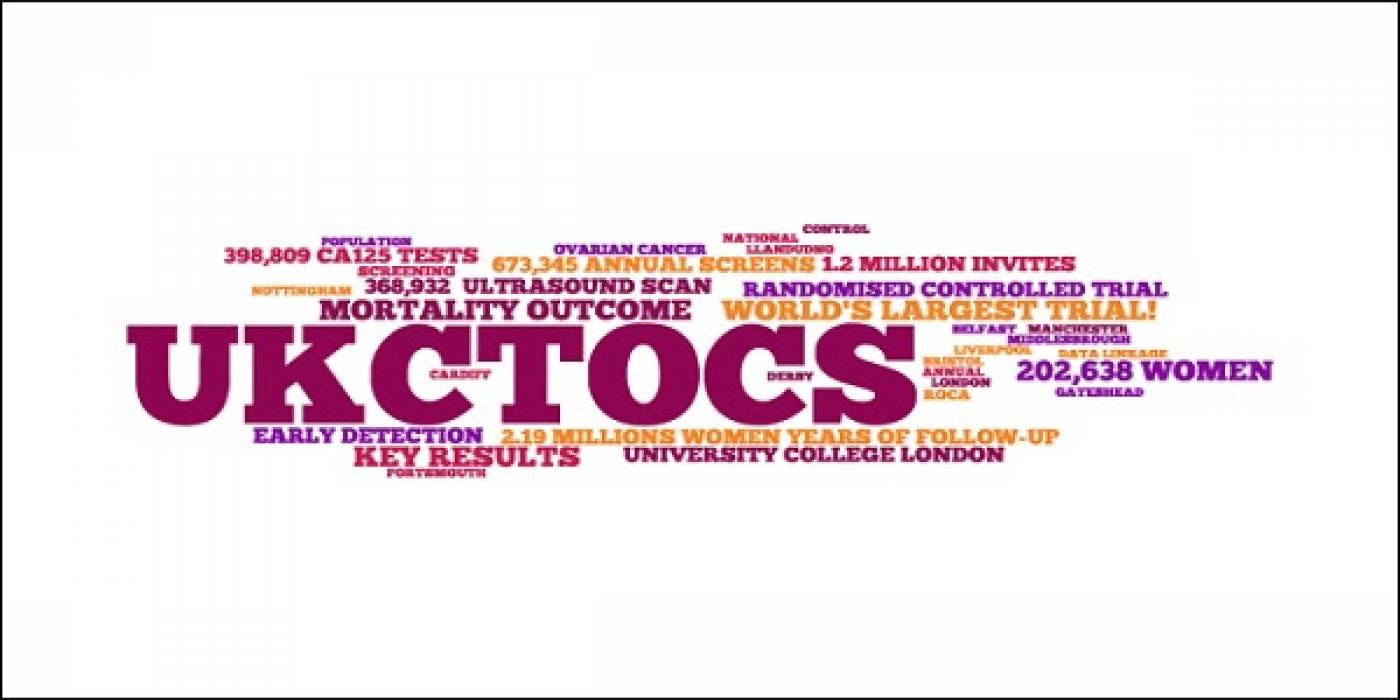
200,000 women recruited over 3 years
Source of recruitment
Women will be invited to participate in the study from the age/sex registers of health authorities geographically related to the 13 regional collaborating centres
Inclusion criteria
- Age 50-74 years
Postmenopausal:
- >12 months amenorrhoea following a natural menopause or hysterectomy OR
- >12 months of hormone replacement therapy commenced for menopausal symptoms
Exclusion criteria
- Bilateral oophorectomy
- Currently active non-ovarian malignancy (excluding skin cancer)
- Women who have had an ovarian malignancy in the past
- Women at high risk of ovarian cancer due to a familial predisposition
- Woman participating in other ovarian cancer screening trials
Overall Trial Design
Screening Tests
Ultrasonography
Ovarian morphology will be assessed for the presence of cysts, cyst volume and characteristics and solid areas. Morphology will be classified as
Normal:
Uniform ovarian echogenicity with or without inclusion cysts or spots of calcifications
OR
One or both ovaries not visualised despite a good view of the iliac vessels.
Simple cyst:
Single cyst with no septae or papillations and thin wall with regular internal outline.
Complex morphology:
All non-uniform ovarian echogenicity excluding simple cyst
CA125
- Serum CA125 levels will be assayed at the Coordinating Centre.
- The result will be used to calculate an individual's ROC (Risk of Ovarian Cancer).
- The ROC for an individual is calculated using a computerised algorithm based on the Bayes theorem which compares each individual's serial CA125 levels to the pattern in known cases of ovarian cancer and controls.
- The closer the CA125 profile to the CA125 behaviour of known cases of ovarian cancer, the greater the risk of ovarian cancer.
- The final result is presented as the individual's estimated risk of having ovarian cancer during the year following the test.
UKCTOCS Psychosocial Arm
UKCTOCS Psychosocial Study is a 10 year project looking at the emotional, social and sexual effects of screening to detect ovarian cancer at an early stage in women aged 50 to 74 in the general population who have passed the menopause. We hope that screening for ovarian cancer will prove helpful but it is important to see if these benefits have costs to women, in particular if some types of screening are more acceptable than others.
200000 women will be asked to join the study at 13 hospitals throughout the United Kingdom. 50000 women will be offered multimodal screening which involves a blood test and ultrasound, 50000 women will be offered transvaginal ultrasonography while 100000 women in the control arm will not receive screening. The type of screening offered or being in the control group will be down to chance – a process known as randomisation - which is the only scientific way to study whether or not screening is worthwhile.
All women will be asked to fill in questionnaires at randomisation. These will ask questions about emotional well being, psychological functioning, sexual activity and what they know, believe and think about ovarian cancer screening. Some women will be randomly chosen for more regular questionnaires (250 women in each screening arm and 500 in the control arm) or if any woman's screening results are not straightforward. They will fill in a set of postal questionnaires every year for 6 years. These also look at their emotional well being, psychological functioning, sexual activity and the acceptability of the screening process after each screen. Different questionnaires will be given if they have surgery and again if the surgery reveals that they have ovarian cancer. These women will then sent a questionnaire at 6 months after surgery.
The main points of the psychosocial study are:
To assess the behavioural, psychosocial and psychosexual responses of women to ovarian cancer screening
- To examine the knowledge, beliefs and attitudes of women in a general population sample to ovarian cancer screening
- To investigate the effect of different screening procedures on women's anxiety, depression and sexual functioning
- To examine women's perception of ovarian cancer risk and the impact that this has on willingness to attend for screening and subsequent compliance
- To compare women's satisfaction with, and acceptability of, the different screening procedures
Volunteers Numbers of women in the study
- 200000 women recruited over 3 years � baseline data collected
- 1000 random sample (250 women in each screening arm and 500 women in the control arm) - followed up regularly
Who can join
Age 50-74 years
Postmenopausal
Who cannot join the study
- Anyone who has had both ovaries removed (Bilateral oophorectomy)
- Anyone who already has cancer
- Women who have had an ovarian cancer in the past
- Women at high risk of ovarian cancer due to their family history
- Woman participating in other ovarian cancer screening trials
Psychosocial Questionnaires
- General Health Questionnaire – 12 item
- Spielberger State/Trait Anxiety Inventory
- Sexual Activity Questionnaire
- Attitude, Knowledge and Perception of Risk Questionnaire
- Acceptability of Screening Questionnaire
- Functional Assessment of Cancer Therapy – Ovarian
Page last modified on 30 apr 13 20:41 by Vijay Devineni